Explore new markets and partnerships through dedicated resource groups
Does your company work with carbon capture, renewable energy or autonomous offshore operations?
Battery waste is more than an environmental challenge – it is a strategic resource for Europe’s energy security.


The batteries are dead. The materials are not. The batteries Europe has already imported could help provide the materials for the batteries it needs next.

Europe’s growing battery waste stream could become an important source of critical raw materials. Our newest member Lithium367 is developing technology to recover and regenerate battery materials – helping keep valuable resources in the European supply chain.
As electrification accelerates, batteries are becoming critical infrastructure for transport, renewable-energy storage, industry and data centres. At the same time, Europe remains heavily dependent on imported battery materials and geographically concentrated supply chains.
By 2030, Europe could be dealing with close to one million tonnes of lithium-ion battery waste and production scrap every year. For Lithium367, this represents not only a recycling challenge, but an opportunity.
– Battery waste is not simply an environmental challenge – it is a strategic European resource and an important part of future energy security, Lithium367 CEO Samaneh Etemadi says.
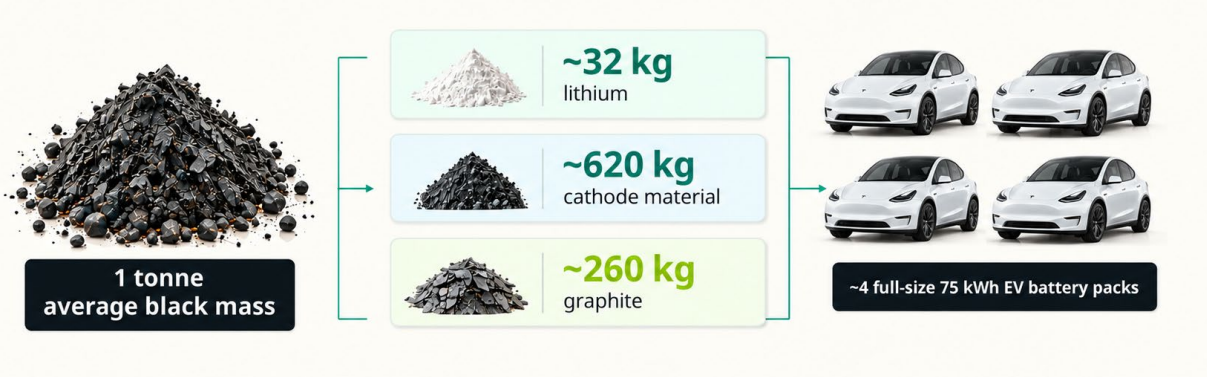
The potential is significant. Just one tonne of "black mass" – the material recovered from shredded lithium-ion batteries – can contain approximately 32 kg of lithium, 620 kg of cathode material and 260 kg of graphite.
According to the company's estimates, that's enough raw material to help produce four new 75 kWh electric vehicle battery packs.
Lithium367 develops integrated recycling processes and direct-regeneration technologies for complex lithium-ion battery waste.
Unlike highly controlled, single-chemistry feedstocks, real-world battery waste can contain different chemistries, formats, binders, electrolytes and impurities. Conventional recycling often involves dissolving materials, followed by several separation and purification steps, which can increase overall costs and generate additional waste streams.
Lithium367 instead uses selective processing designed to preserve material value and improve cost efficiency. The goal is to recover critical materials while retaining valuable cathode structures, creating a shorter pathway back to materials suitable for battery production.
The company is also developing methods to recover and reuse process chemicals, working towards a closed-loop approach that reduces the need for fresh chemicals and limits waste generation.
Based at Oslo Science Park, Lithium367 works closely with battery recyclers, manufacturers, technology providers, research organisations and industrial partners across Europe.
Rather than simply extracting metals, the company aims to produce materials that can return to the battery supply chain, including high-purity lithium products, regenerated cathode materials, and recovered graphite.
The technologies are being developed as modular solutions intended for integration into existing recycling operations.
Through collaboration with Danish partners under the Eurostars programme, Lithium367 is scaling up its recycling and regeneration technologies for battery waste from light-mobility applications. Coordinated by Lithium367, the project combines process development and scale-up with validation of recovered materials for reuse in battery production.
Web: lithium367.com
Contact mail: Samaneh.Etemadi@lithium367.com